Was The Little Mermaid Hans Christian Andersen himself?
The Little Mermaid (with sequels) is a popular animated movie made by Disney. However, if we look beyond plain entertainment, the original fairy tale by Hans Christian Andersen offers much more. While Andersen’s Little Mermaid is one of his best, it is also among his saddest stories and features many autobiographical elements. Next, let’s examine the surprising history of this tale, where even the great master of storytelling lost control.
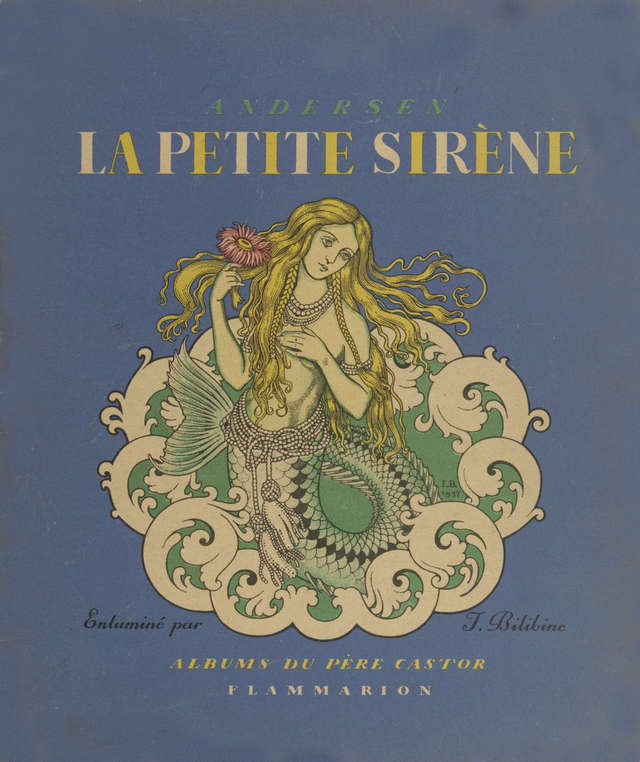
(Cover of French picture book illustrated by Ivan Bilibin)
Very short summary (Andersen’s version)
Little Mermaid is the youngest daughter of a Sea King. Each child must wait until their fifteenth birthday before going to the surface. For the youngest, waiting is hard as she listens to her older sisters’ stories about wonders on the coast, but finally, the day comes, and she can explore the world above.
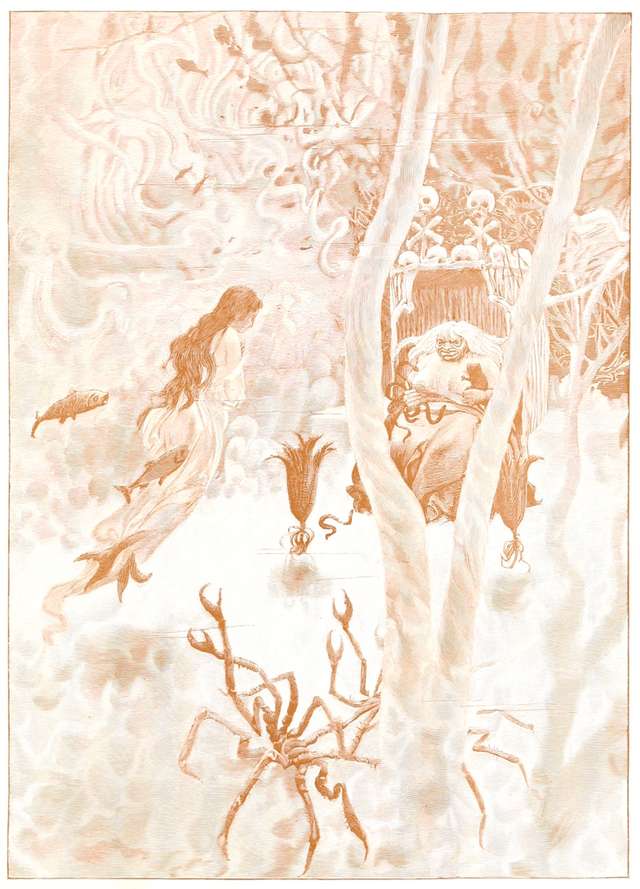
(illustration by Hans Tegner)
The Little Mermaid falls in love with a human. They are both of royal origins, but belong to very different worlds. Mermaid tries to find a way to fit into the prince’s world, and it seems that with the help of the witch (and a lot of sacrifice), she can make it. But he falls in love with another girl. Little Mermaid lost her family and her beautiful voice and her feet, which she got in exchange for a fishtail, are hurting with every step – all for nothing. The witch offers her a second chance, but she should kill the prince for that.
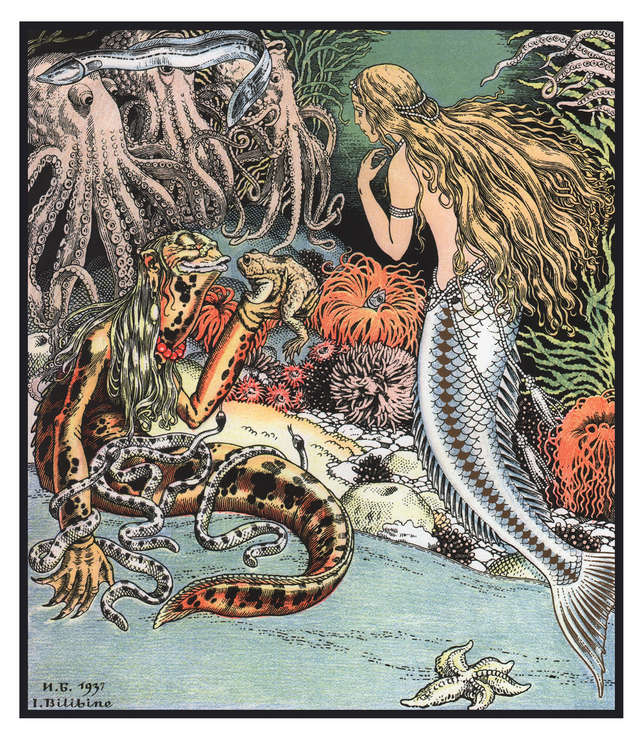
(illustration by Ivan Bilibin)
Instead of that, the mermaid chooses to die.
Not a very optimistic fairy tale, right?
Who wrote The Little Mermaid, anyway?
Although we must credit Andersen with authorship, we should note that his Little Mermaid is not entirely original. The basic plot is copied from Undine, written by Friedrich de la Motte Fouque. Undine is a romantic novel, based on a French folk tale, and was one of the most popular books of the 19th century. Andersen was familiar with it for sure. While he drew on the improbable love between a human and a fairy creature and a quest for the soul, he also added many original twists and enriched the story with autobiographical elements.
How can writing expose the writer?
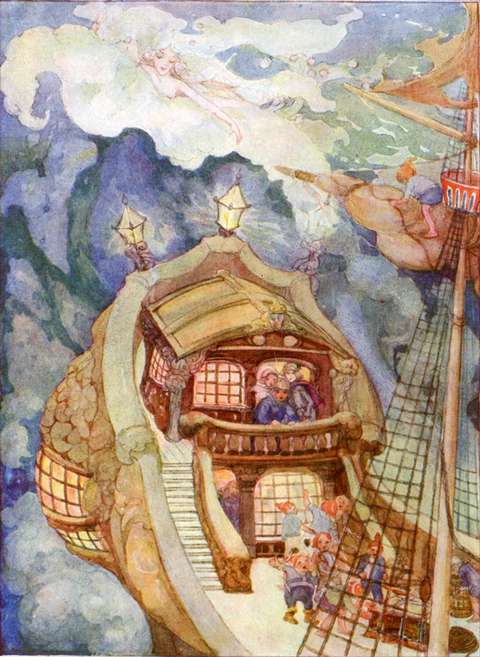
(illustration by Anne Anderson)
Even if we have never heard about the other versions of Little Mermaid and don’t really care about Andersen’s personal involvement in writing, we can spot a few moments in the story where things don’t look just as they are supposed to. Here are three of them:
- The situation where the mermaid rescues the prince but backs away when she could take credit for her bravery is pretty contradictory to her character as presented before and after that. But it tells us more about Andersen’s personality than he probably wanted to tell in any of his three autobiographies, written during his life. He was extremely shy in personal relations, and he never overcame the problem of expressing and confronting his true feelings. Although he was in love on more than a few occasions, he never managed to build an intimate relationship.
- The scene where the title character gets a chance to get even, if she kills the prince, is wrong from the very beginning. Well, not exactly wrong, but certainly not written in the tradition of folktales. With all the painful self-sacrifice, it actually looks more like a passage from the Holy Bible. Hans Christian Andersen was very religious, and he found deep consolation in his faith. If we look at the fairy tale about the little mermaid as a retelling of his personal problem, it makes perfect sense to understand it as a kind of religiously inspired statement.
- The afterword with explanation of the rules by which the mermaid can achieve her main goal (immortal soul) sooner if children behave, and later if they don’t. This definitely sounds more like preaching, not storytelling. Listeners don’t appreciate this kind of blackmailing, and we can say the writer of Andersen’s quality should never afford to do that.
All of this can be used as proof of how deeply involved Andersen was in the story, if he made such ‘mistakes’, but we can actually confirm the theory with documents: personal letters and the writer’s diary. Instead of doing that, we’ll try to stay on the brighter, although a bit yellowish side, and explain who the real people are, who inspired Andersen’s retelling of this popular fairy tale.
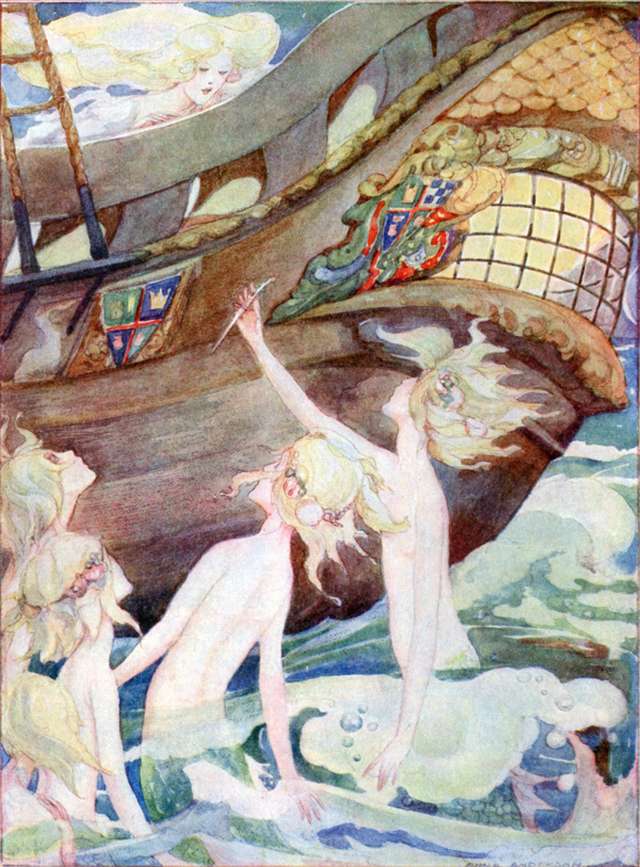
(illustration by Anne Anderson)
Real characters in the story of the Little Mermaid
Real Little Mermaid
The title character is Hans Christian, of course. She not only resembles his personal love story (unfulfilled) but also some of his characteristics. Both are secluded, both very curious, both fascinated by new, unexplored places, and being of royal origin (Andersen believed he was an illegitimate son of Christian VIII), they seek attention from nobility.
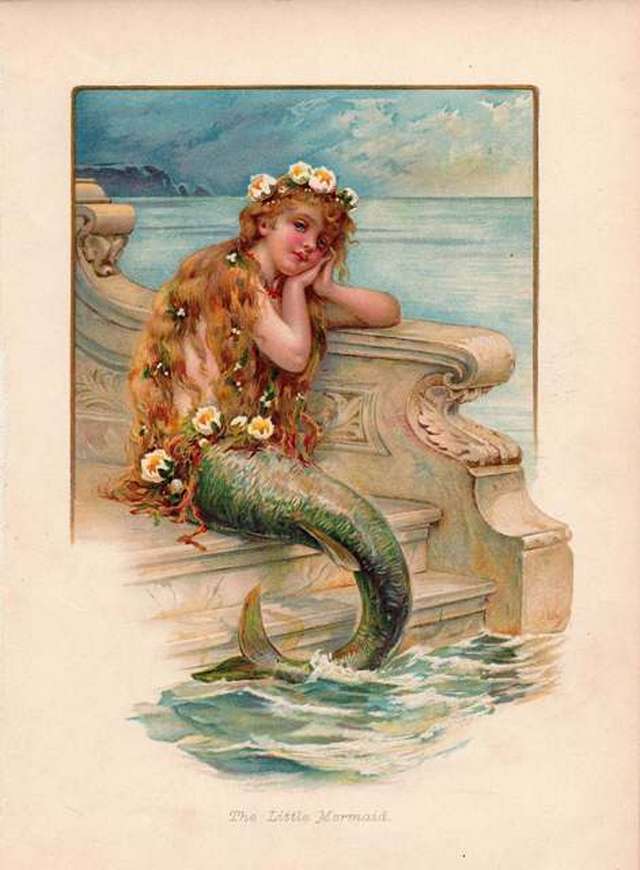
(illustration by Elisabeth Stuart Hardy)
There is more. The greatest storyteller of all time tried to enter the world of theatre (his initial plan, when he left his home, was ‘to become famous’) as a singer and dancer, much before he wrote the first lines of any kind of fiction. He was even accepted in the Royal Danish Theatre thanks to his marvellous tenor, but his voice soon changed, and he lost the job. As a dancer, he was not so deprived of skill as elegance because he was too tall. All details are closely related to the mermaids who lost family, voice, and exchanged their fish tails for human legs (she could dance gracefully, but every step hurt).
As we can see, the mermaid is making a sacrifice after a sacrifice to get closer to the prince, and it is obvious he likes her company as well. On the other hand, he stays distant, and in some cases, their relationship doesn’t even resemble friendship. We find out that he allows her to sleep at the doors of his bedroom, and we get the feeling he thinks about her more like a pet.
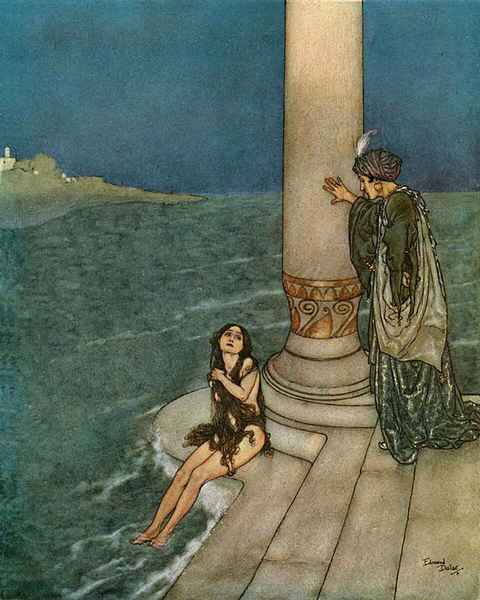
(illustration by Edmund Dulac)
Real Prince
Who was the real prince in Andersen’s life? Who was nice, polite, but always reserved in all communications with the famous storyteller? If we recognize the writer in the mermaid, can we presume the prince was actually a lady?
Not at all! Although Hans Christian Andersen was seriously in love several times, biographers agree the prince in The Little Mermaid could be only one person: Edvard Collin. Edvard Collin was the son of Jonas Collin, director of the Royal Danish Theatre and benefactor to Hans. Jonas arranged additional education for Hans and convinced King Frederick VI to pay for it. Hans Christian and Edvard became good friends, but with time, Andersen’s affection grew into infatuation. When he confessed his love, Edvard stayed friendly, but kept his distance. He never even accepted Andersen’s proposal to be addressed as a friend and family member (they were living under the same roof for years after all) and insisted on staying formal to the very end of their lives. On the other hand, he didn’t mind being on more friendly grounds with members of the upper middle class (like Wilhelm Wanscher, for instance), whose family Collin belonged to, and Andersen didn’t.
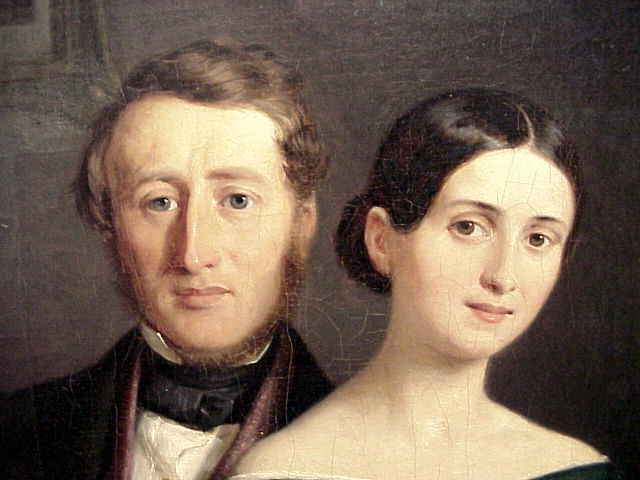
(portrait of Edvard colin and Henriette Thyberg)
Henriette Oline Thyberg
Henriette Thyberg, a family friend, married Edvard Collin in August 1836, the same year that the fairy tale The Little Mermaid was published. She was also a member of the bourgeois class and a perfect match for Edvard. They had four kids: three daughters (two of whom died as children) and a boy, and they all became something of an extended family for Hans Christian, who wasn’t very skilled with paperwork and relied on Edvard’s help with publishing contracts and other business aspects of his creative work. In return, he built a monument to Edvard and Henriette’s daughter, Gerda, who died when she was only four, in another masterpiece: The Snow Queen, in which the main character is modeled (and named) after the deceased girl.
Although Henriette, in a way, defeated Hans in a ‘fight’ for Edvard’s heart, they all remained friends throughout their lives and were even buried in the same grave for several years. So we can’t be surprised to find that the mermaid could not harm the prince when she saw him sleeping in the bed with his bride. She would rather choose her own death.
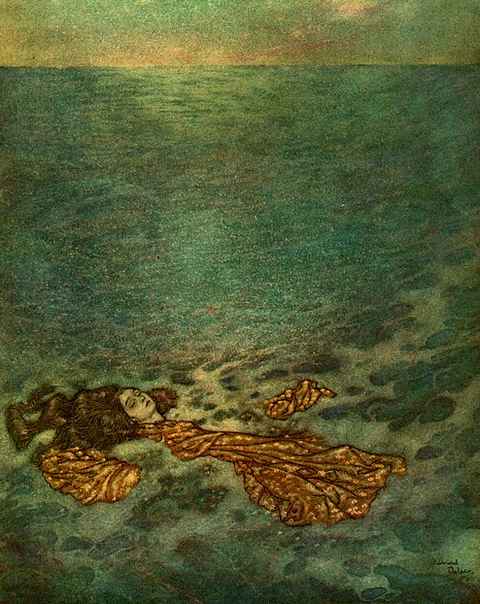
(illustration by Edmund Dulac)
What about other characters?
We could go on and on with decoding the fairy tale, maybe starting with the Little Mermaid’s sisters who tried to get her back in their kingdom underwater, just like the writer’s real family members on several occasions unpleasantly reminded him of his origin, but there is no need for that.
The fact is, this particular fairy tale was not meant to be read to children. It was not even meant to be published. The initial intention of H. c. Andersen was to write a beautiful, sad, and slightly accusing love letter to the biggest love of his life. Yes, just like we can say The Puss in the Boots could be read as Perrault’s cynical biography, we can understand The Little Mermaid as a romantic love letter in which, despite some of the above-mentioned imperfections, it is one of the best literary works ever.
The reason is probably very simple. We can all relate to the pains of the rejected siren, just like we can all relate to a Cinderella at certain points in our lives. When a story touches so many hearts in the audience, it’s a great story. We don’t need a literary critic to explain that.
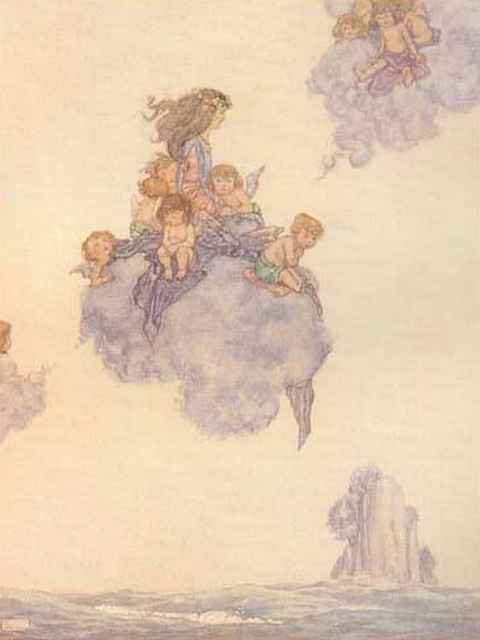
(illustration by William Heath Robinson)
In Andersen’s Fairy Tale, the Little Mermaid Dies!
But Andersen concluded the story on an optimistic note, implying that she would eventually attain an immortal soul. However, he also made one of the biggest mistakes as a writer. He wrote that kids can speed up (or delay) the process of their admission to heaven by ‘being good.’ This suggestion equals blackmail.
Edvard Collin and his wife Henriette were later buried with Andersen. However, their family members moved the Collins’ bodies after some years to the family plot in another cemetery.
Leave a Reply