Bremen Town Musicians – a classic story with invaluable lessons
The timeless messages of the classic fairy tale, The Town Musicians of Bremen, by the Grimm Brothers, have stood the test of time. It’s a story about respect, cooperation, and bravery.
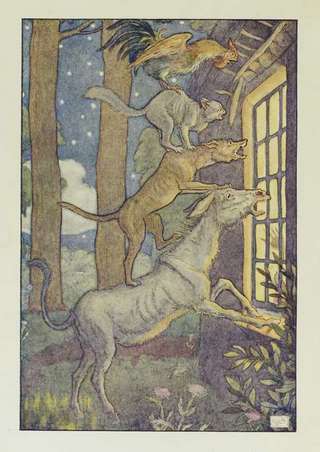
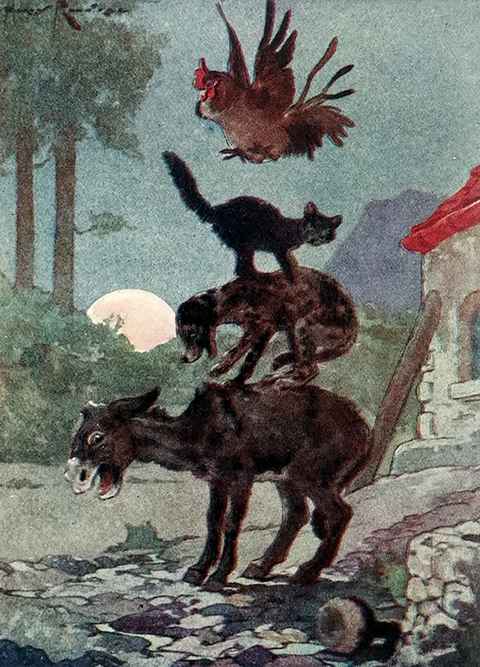
Illustrations by Leonard Leslie Brooke (left), and Harry Rountree (right)
This fairy tale is a bit different than most classic stories for kids. It has animals in the main roles, and all the people in the story are presented in a bad light. Of course, we need to understand the narrative approach – animals are just examples of individuals who have lost their positions in society and are trying to find a new meaning in the slowly but surely approaching ends of their lives.
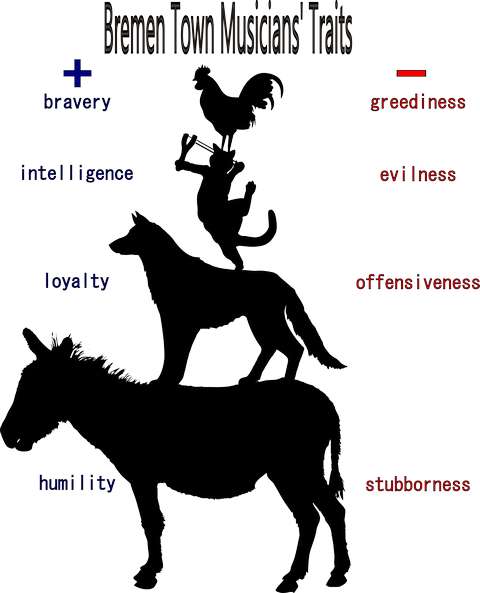
All the chosen animals also carry rich symbolism, so we can perceive them as characteristics, functions, or traits in a dramatic expression of social conditions. To make them more relatable, they picked animals that most of us are familiar with. This makes them feel more at home. There are dozens of similar stories with different numbers, sometimes up to six animals, but all of them always belong to livestock and poultry. A bull, a duck, or a sheep are just a few examples. All of them can also be associated with positive and negative traits that give depth and humanity to the characters.
Different versions of this story are found in the folklore of many countries all over the world, from Norway to South Africa. In these cases, Bremen can be replaced with another fictional or real location, or left unspecified.
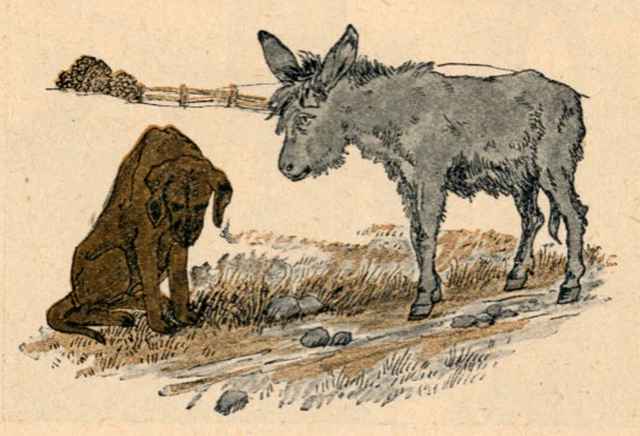
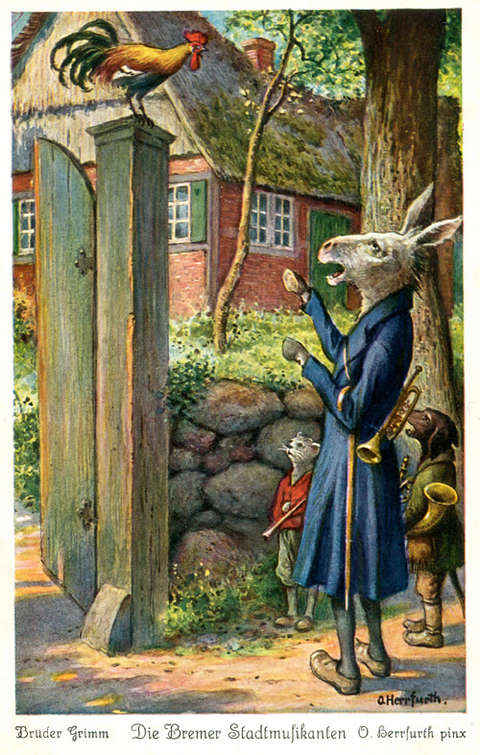
Illustration by Paula Ebner (left) and postcard by Oskar Herrfurth (right)
Such a scholarly approach is even more understandable if we know the circumstances in which this story was written. Let’s explore a few interesting facts about the Bremen Town Musicians and try to learn a lesson or two by the way.
Short Summary of Bremen Town Musicians
A donkey becomes old, slow, and weak. He realizes his master will get rid of him, so he leaves him and goes toward Bremen, where he plans to become a town musician. On his way, he meets a dog with a very similar perspective, and the animals join their forces.
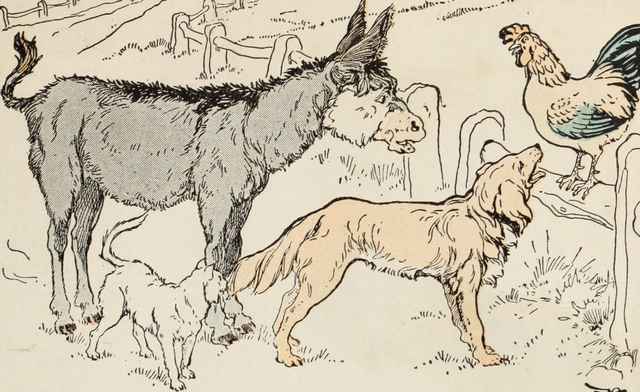
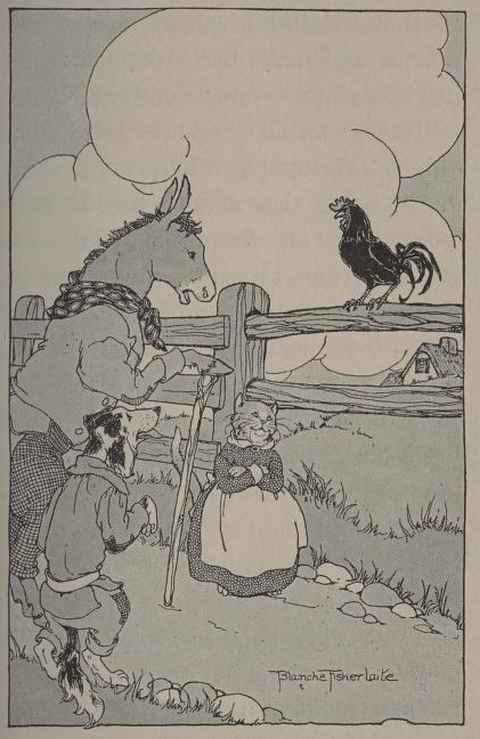
Illustrations by Frederick Richardson (left) and Blanche Fisher Wright Laite (right)
Before the end of the day, a cat and a rooster become members of the group as well.
Night comes before they reach Bremen, so they try to find shelter in the woods. There, they see a hut with a few robbers inside. They have their loot and a lot of food on the table. Animals make some kind of pyramid and look like some kind of monster. They scare the robbers out of the hut.
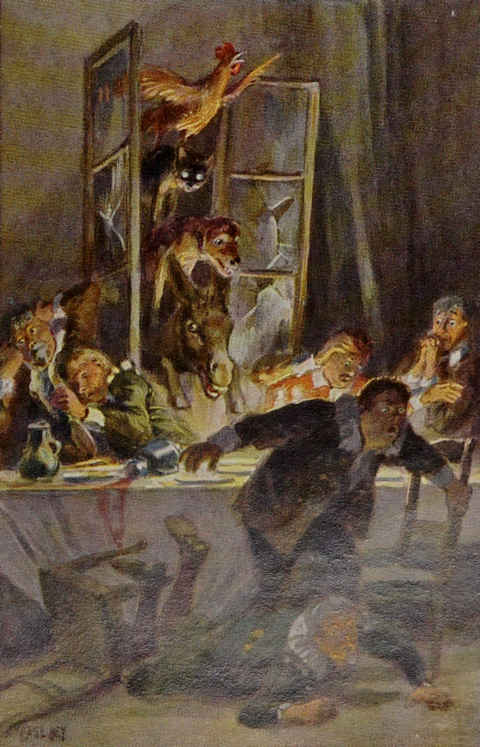
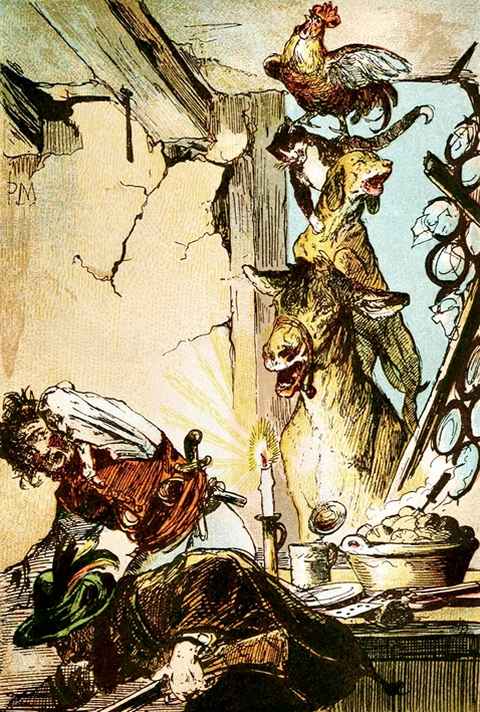
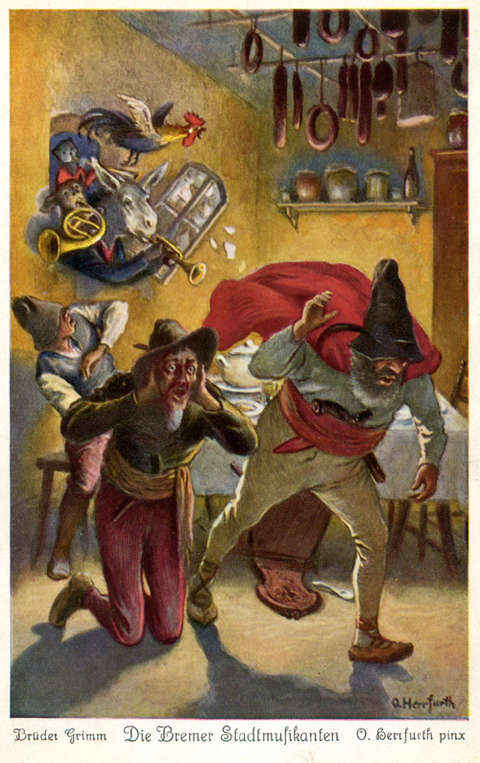
Illustratons by Paul Hey (left), Paul Friedrich Meyerheim (middle), and postcard by Oskar Herrfurth (right)
They enjoy food, and each one of them finds a place to sleep.
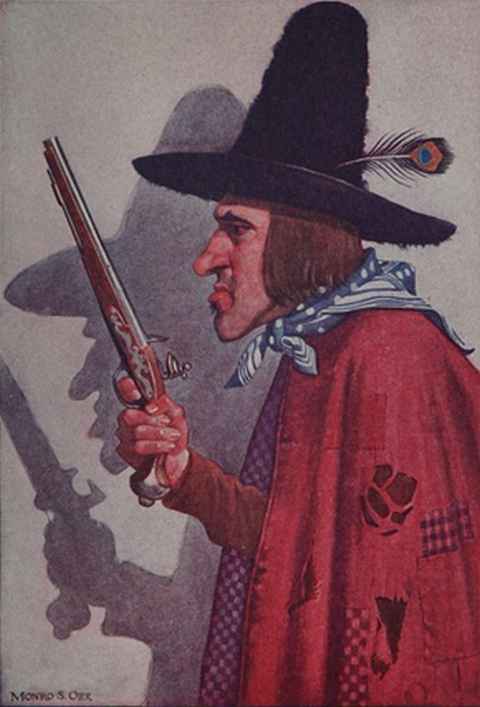
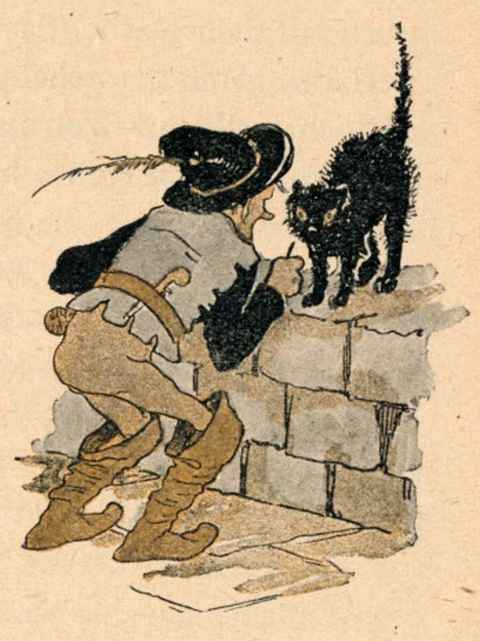
Illustrations by Monro Scott Orr (left) and Paula Ebner (right)
Later, one of the robbers comes back. It’s dark, so he tries to make a fire in the heath. But there is the cat who jumps into his face, hissing and scratching. The robber escapes through the doors, but the dog that lies behind bites him. In the yard, a donkey kicks him, and for the grand finale, a rooster comes at him from the roof.

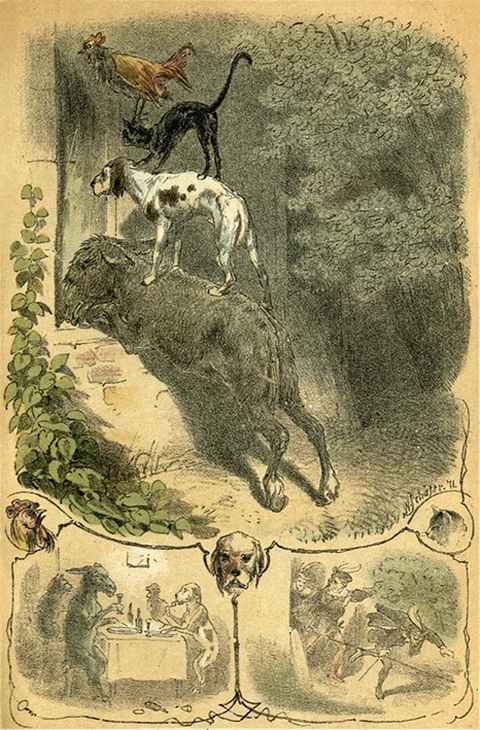
Postcard by Felix Elsner (left) and illustration by Wilhelm Schaefer (right)
When the robber returns to his gang, he explains that different monsters attacked him. Others, seeing his wounds, decide never to return there. The Town Musicians of Bremen stayed there and enjoyed their lives without ever reaching Bremen.
Why Bremen?
Most fairy tales don’t say exactly where they take place, but this one tells us that animals go to Bremen. Bremen has been around for over 1200 years and has managed to stay pretty independent for most of that time. It was one of the few cities where an ordinary man had more chances to prosper than in others. For a long time, it was one of the main ports for Europeans, particularly Germans, heading to America in search of a better life. It’s still the capital of the German state, the Free Hanseatic City of Bremen, made up of just two cities: Bremen and Bremerhaven.
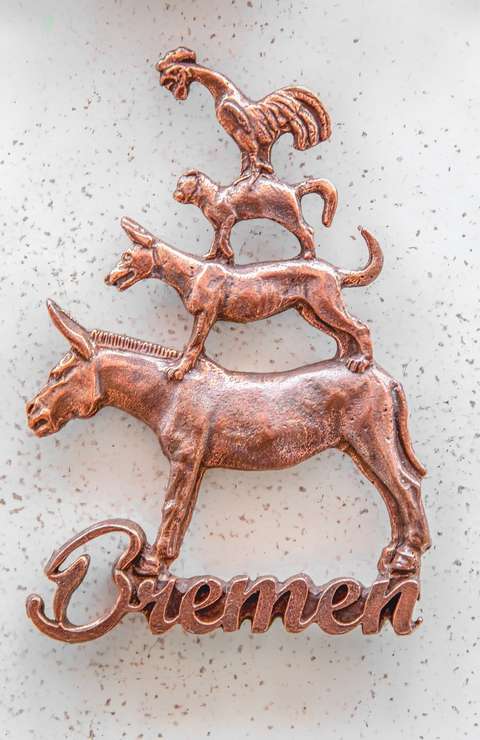
It’s very likely that the donkey in the story opted for Bremen because of its image of the place, where you can get a second chance. Or more chances than in other places. Or, any chance at all. Choosing a musical career is not surprising as well. In medieval Europe, traveling musical bands with animals playing simple instruments were quite popular, and Bremen is a town with a long tradition of festivals and similar events.
Is this story so different than other classic fairy tales?
At first glance, the Grimm Brothers’ The Bremen Town Musicians looks quite different. Yet it’s still a story where one (or more) characters try to improve their life. Finding partners, finding treasures, and improving social status are major goals of all the best stories, and this one is no exception. Members of this unusual group leave their homes (the standard beginning of countless fairy tales), find partners (in this case, friends, not spouses), and earn a fortune (the robbers’ hut is full of food and stolen stuff).
Like in all great stories, the protagonists had to conquer mighty opponents and break at least some rules. In this scenario, they have the opportunity to escape the constraints imposed by society’s expectations (in this case, facing a certain death) and defeat a group of robbers. The robbers are stronger and armed, but the animals are smart and work as a team. Cunningness defeats brute force again. There are no kings or queens in this tale, but the animals clearly conquer their very own kingdom where they intend to live happily ever after.
To make our case even more convincing, let’s borrow, for instance, an observation from Maria Tatar, who noticed that all four animals tested their possible places for sleeping just like Snow White or Goldilocks checked several beds before choosing one for resting.
The story of second chances
We can explain the popularity of the Bremen Town Musicians in different contexts. One of them is definitely the critical view of a capitalist society in which people are valued only for their usefulness. When the donkey can’t carry as much burden as before, it’s best to make glue of it. Metaphorically speaking, we can clearly see an aging human in him.
Yes, we can say that everybody’s time is up one day, but the donkey refuses this simplistic approach. He is willing to pursue a second chance and at least try to do something else. If he can’t pull the cart, he might play a lute. While we may see him as a rebel at first, we soon learn he is not alone, which brings us to another valuable lesson. Animals can act as a group. They join their abilities to chase away the robbers and find a place to live. Robbers, on the other hand, take an ‘everybody for himself’ approach and lose everything.
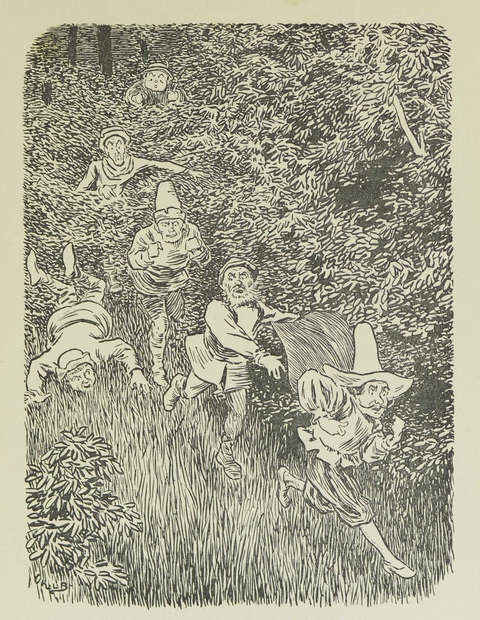
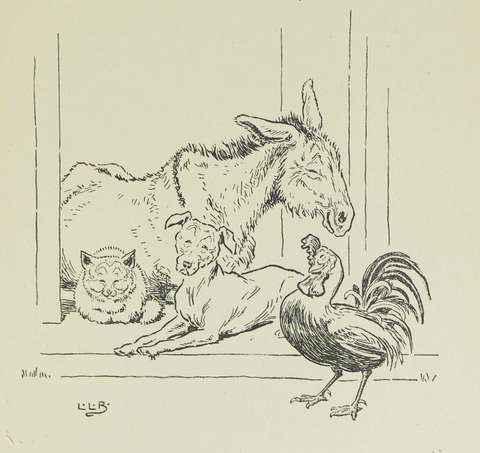
Illustrations by Leonard Leslie Brooke
One obvious message of the fairy tale is that teamwork triumphs over selfishness. Another is probably the importance of maintaining optimism and focusing on the future.
All used images are in the Public Domain or used by permission of the author.
When you face trouble, do you try to see it as a challenge and an opportunity?
Leave a Reply